Travel guide · Jordan
Petra travel guide
The Nabataeans' rose-red city of rock-cut tombs, reached through a narrow gorge
Updated By the AMZBooking editorial team
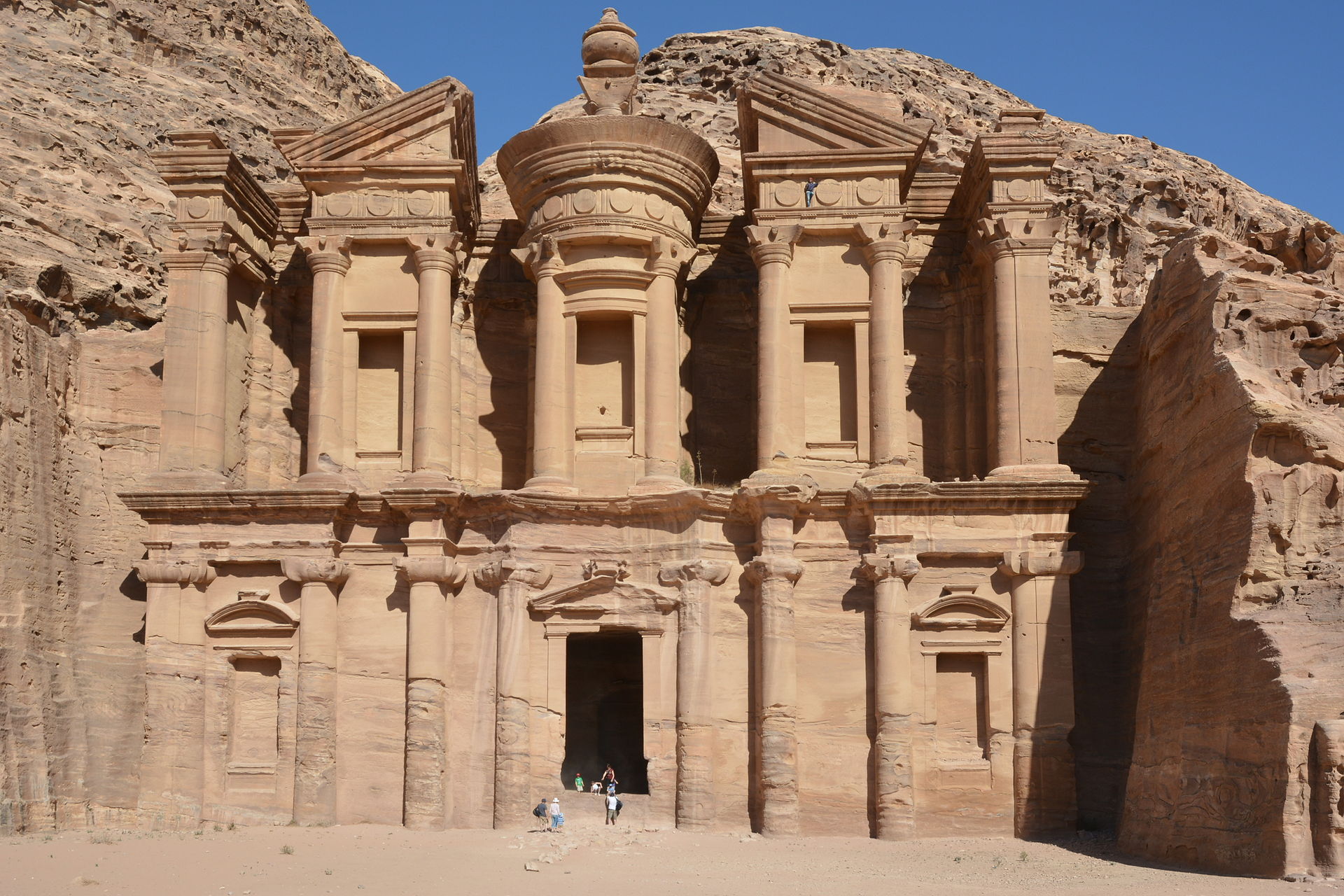
Photo: Azurfrog, CC BY-SA 3.0

Quick answer
Petra was the capital of the Nabataean kingdom, a trading people who carved temples and tombs into the sandstone cliffs of southern Jordan from around the 1st century BC. Visitors enter through the Siq, a 1.2 km gorge that ends at the facade of the Treasury, then continue past the Street of Facades, the theatre and the Royal Tombs to the temple of Qasr al-Bint, with an 800-step climb to the Monastery beyond. The town of Wadi Musa, beside the entrance, is the base for hotels and restaurants, and Little Petra, Wadi Rum and Shobak Castle are within easy reach. Plan 2 days for a first visit; the best months are March–May and October–November.
Key facts
- Country
- Jordan
- Best time to visit
- March–May and October–November
- Ideal stay
- 2 days
- Main airports
- AMM, AQJ
- Mid-range daily budget
- $130–$250 per person (estimate)
- Known for
- The Treasury (Al-Khazneh), The Siq, The Monastery (Ad Deir) and Nabataean rock-cut tombs
Why visit Petra
- The walk through the Siq to the first sight of the Treasury is one of the great arrivals in world travel.
- Petra covers far more than its famous facade: hundreds of carved tombs, a theatre, temples and mountain trails to the Monastery and the High Place of Sacrifice.
- Back trails such as Al-Khubtha and the route from Little Petra give quieter views over the main valley.
- Petra by Night, when the Siq and the Treasury are lit by candles, shows the site in a different light.
- Wadi Rum's desert camps, the Crusader castle of Shobak and the Red Sea at Aqaba are all within about two hours.
Top things to do
The six sights most first-time visitors build a trip around. See all 13 things to do.


Nature · Petra Archaeological Park
The Siq
Petra's main entrance is a winding gorge about 1.2 km long, its walls rising up to around 80 metres and narrowing in places to a few metres apart.
- Time needed
- 30–45 minutes each way
- Cost
- Expensive
- Iconic
- Nature
- Photo spot
- Kids


Historic site · Petra Archaeological Park
The Treasury (Al-Khazneh)
The facade that appears at the end of the Siq is about 40 metres high, carved from the cliff in the 1st century AD, probably as a royal tomb.
- Time needed
- 30 minutes
- Cost
- Expensive
- Iconic
- History
- Architecture
- Photo spot
- Kids
Historic site · Petra Archaeological Park
Royal Tombs
Carved into the face of Jabal al-Khubtha, the Royal Tombs include the Urn Tomb, with its vaulted terrace later used as a Byzantine church, the small Silk Tomb with swirling bands of red, yellow and white sandstone, the Corinthian Tomb and the multi-storey Palace Tomb.
- Time needed
- 1 hour
- Cost
- Expensive
- Iconic
- History
- Architecture
- Photo spot
- Views

Historic site · Petra Archaeological Park
The Monastery (Ad Deir)
Reached by a stairway of about 800 rock-cut steps from the end of the Colonnaded Street, the Monastery is a facade nearly 50 metres high and wide, larger than the Treasury and carved in the 1st century AD.
- Time needed
- 2–3 hours including the climb
- Cost
- Expensive
- Iconic
- Views
- Active
- History
- Outdoors
Experience · Petra Archaeological Park
Petra by Night
On several evenings a week, the path through the Siq is lined with candles in paper bags, and visitors walk in near-silence to the Treasury, where hundreds more candles light the square for a short programme of Bedouin music and storytelling.
- Time needed
- 2 hours
- Cost
- Mid-priced
- After dark
- Couples
- Iconic
Historic site · Petra Archaeological Park
Street of Facades and the Theatre
Beyond the Treasury, the valley widens past rows of tombs with stepped crow's-foot tops, then reaches a theatre cut into the mountainside, which the Nabataeans carved and the Romans later enlarged to seat several thousand people.
- Time needed
- 45 minutes
- Cost
- Expensive
- History
- Architecture
Where to stay
Visitor Centre area is the easiest base for a first visit. Compare all 6 areas.
$$$$ · Best for first-timers, families and luxury
Visitor Centre area
Hotels right at the entrance gate at the bottom of Wadi Musa
$ · Best for budget, solo travellers and food lovers
Wadi Musa town centre
Budget hotels, shawarma shops and the central roundabout
$$$ · Best for couples, quiet stays and luxury
Upper Wadi Musa
Hillside hotels with views over the Petra mountains
$$$ · Best for couples, quiet stays and culture
Taybeh
Hilltop village south of Wadi Musa with a restored heritage hotel
What to eat
- Mansaf — Jordan's national dish: lamb cooked in jameed, a tangy sauce of fermented dried yoghurt, served on rice over thin shrak bread and scattered with almonds and pine nuts.
- Maqluba — Rice, chicken and fried vegetables such as aubergine and cauliflower are layered in a pot and turned upside down onto a platter at the table, hence the name, which means 'upside down'.
- Zarb — The Bedouin barbecue: chicken, lamb and vegetables are placed on racks in a pit, covered with sand and slow-cooked by hot coals for a few hours, giving smoky, tender meat.
- Galayet bandora — Tomatoes slowly fried with garlic, chilli and olive oil until jammy, eaten with bread.
- Falafel and hummus — Crisp chickpea falafel with hummus, pickles and fresh bread is the everyday breakfast and cheap lunch in Jordan, often with ful (stewed fava beans) on the side.
- Bedouin tea — Sweet black tea brewed over a fire with wild sage (maramiya) or thyme, served in small glasses.
When to go
The best times to visit Petra are March to May and October to November, when days are warm and dry enough for the long walks and climbs but not hot. Summer afternoons regularly reach 30°C or more in the open valleys, so early starts are essential, while December to February is cold, occasionally wet, and much quieter. Ramadan moves about 11 days earlier each year; the site stays open, though some local restaurants open only after sunset.
| Season | Months | What to expect |
|---|---|---|
| Spring | March–May | Wildflowers and mild, dry weather; the most popular time to visit, with the busiest trails in April. |
| Summer | June–August | Hot, dry afternoons with little shade; walk at dawn and late afternoon and rest at midday. |
| Autumn | September–November | Warm days and cool nights, with excellent hiking conditions and busy months in October. |
| Winter | December–February | Cold mornings, occasional rain and rare snow, but quiet trails and lower hotel prices. |
Getting there and around
Queen Alia International Airport near Amman is about 3 hours by car from Petra along the Desert Highway, and King Hussein International Airport in Aqaba is about 2 hours away. There is no airport at Petra; private transfers, hire cars, taxis and coaches cover the journey.
Inside Petra you walk: the main trail from the Visitor Centre through the Siq to Qasr al-Bint is about 4 km one way, and the Monastery adds an 800-step climb. Wadi Musa is small, with taxis and hotel shuttles connecting the town, the gate and Little Petra.
Plan your days
One full day covers the Siq, the Treasury, the Royal Tombs and the climb to the Monastery at a brisk pace. Two days allows the High Place of Sacrifice, the Al-Khubtha viewpoint and Little Petra; a third day suits hikers heading to Jabal Haroun or entering via the back trail.
Practical information
- Currency
- JOD
- Language
- Arabic and English
- Plugs
- Mainly Type C, F and G sockets, 230 V, 50 Hz
- Tap water
- Drink bottled or filtered water; tap water is not recommended for visitors.
- Emergency number
- 911
- Tipping
- About 10% in restaurants is customary if no service charge is added.
The main risks are heat, dehydration and falls on steep, unfenced trails, especially in the heat of the day. Sellers offering donkey, camel and horse rides can be persistent; ride only on animals that look healthy and agree prices first.
Flights to Petra
Questions travellers ask
+How many days do you need in Petra?
One full day covers the Siq, the Treasury, the Royal Tombs and the climb to the Monastery at a brisk pace. Two days allows the High Place of Sacrifice, the Al-Khubtha viewpoint and Little Petra; a third day suits hikers heading to Jabal Haroun or entering via the back trail. How to split your days.
+When is the best time to visit Petra?
The best times to visit Petra are March to May and October to November, when days are warm and dry enough for the long walks and climbs but not hot. Summer afternoons regularly reach 30°C or more in the open valleys, so early starts are essential, while December to February is cold, occasionally wet, and much quieter. Ramadan moves about 11 days earlier each year; the site stays open, though some local restaurants open only after sunset.
+What is Petra known for?
The Treasury (Al-Khazneh), The Siq, The Monastery (Ad Deir), Nabataean rock-cut tombs, Petra by Night, Bedouin hospitality and Rose-red sandstone. The walk through the Siq to the first sight of the Treasury is one of the great arrivals in world travel.
+Is Petra expensive?
Petra is moderately priced for international visitors: a mid-range trip costs roughly $130–$250 per person per day before flights (AMZBooking estimate). Costs and money-saving tips.
+Do you need a car in Petra?
Not for Petra itself, which is walked. A car or driver is very useful for getting there and for combining it with Wadi Rum, Shobak, Dana and the King's Highway.