Things to do · Hiroshima · Japan
17 best things to do in Hiroshima
17 sights and experiences ranked for a first visit, with honest notes on time, cost and crowds.
Updated By the AMZBooking editorial team

Quick answer
The essential sights in Hiroshima are Hiroshima Peace Memorial Park, Atomic Bomb Dome and Hiroshima Peace Memorial Museum. Of the 17 picks below, 7 are free, 5 work on a rainy day and 3 suit children. Allow about 3 days to see the highlights without rushing.
Key facts
- Top sight
- Hiroshima Peace Memorial Park
- Free sights
- 7
- Good on a rainy day
- Hiroshima Peace Memorial Museum
- Time to see the highlights
- 3 days
At a glance
| Sight | Area | Time needed | Cost |
|---|---|---|---|
| Hiroshima Peace Memorial Park | Peace Park and Hondori | 1.5–2 hours | Free |
| Atomic Bomb Dome | Peace Park and Hondori | 30 minutes | Free |
| Hiroshima Peace Memorial Museum | Peace Park and Hondori | 2 hours | Low cost |
| Itsukushima Shrine | Miyajima | 1–1.5 hours | Low cost |
| Children's Peace Monument | Peace Park and Hondori | 20 minutes | Free |
| Mount Misen | Miyajima | Half a day | Mid-priced |
| Daisho-in Temple | Miyajima | 45 minutes | Free |
| Hiroshima Castle | Hakushima and the castle | 1 hour | Free |
| Shukkei-en Garden | Hakushima and the castle | 1 hour | Low cost |
| Okonomimura | Peace Park and Hondori | 1 hour | Low cost |
| Hondori Shopping Arcade | Peace Park and Hondori | 1 hour | Free |
| Hiroshima Orizuru Tower | Peace Park and Hondori | 45 minutes | Mid-priced |
| Miyajima Omotesando shopping street | Miyajima | 1 hour | Low cost |
| Hiroshima Museum of Art | Hakushima and the castle | 1–1.5 hours | Mid-priced |
| Mitaki-dera | Nishi-ku | 1.5 hours | Free |
| Carp game at Mazda Stadium | Hiroshima Station area | 3–4 hours | Mid-priced |
| Hiroshima City Museum of Contemporary Art | Hiroshima Station area | 1.5 hours | Low cost |
The 17 best things to do


Park · Peace Park and Hondori
1.Hiroshima Peace Memorial Park
Laid out by architect Kenzo Tange on the river island close to the bomb's hypocentre, the park lines up the Cenotaph for the A-bomb victims, the Flame of Peace and the Atomic Bomb Dome along one axis. Around it stand dozens of memorials, including the Peace Bell, which visitors may ring, and the Memorial Mound.
Stand behind the cenotaph to see the flame and the Atomic Bomb Dome framed in one line, then walk the riverbank.
- Time needed
- 1.5–2 hours
- Cost
- Free
- Iconic
- History
- Free
- Outdoors

Historic site · Peace Park and Hondori
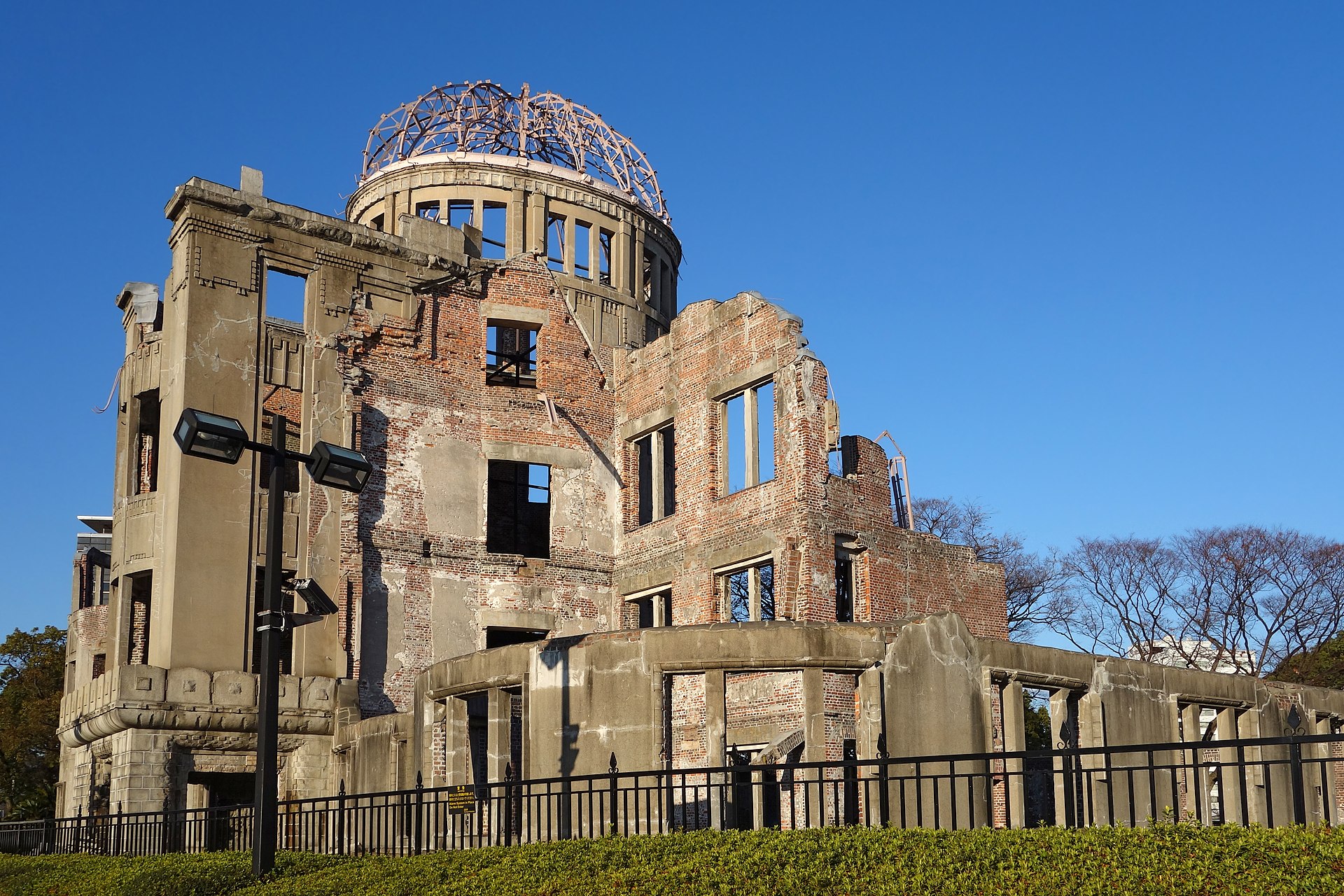
2.Atomic Bomb Dome
The skeletal ruin of the former Hiroshima Prefectural Industrial Promotion Hall stood about 160 m from the hypocentre and was one of the few structures left standing. Preserved as it was after the blast, it is a UNESCO World Heritage site and the city's defining memorial.
See it twice: in daylight from the riverbank and after dark, when it is lit and the area is quiet.
- Time needed
- 30 minutes
- Cost
- Free
- Iconic
- History
- Free
- After dark


Museum · Peace Park and Hondori
3.Hiroshima Peace Memorial Museum
The museum documents the bombing and its aftermath through victims' belongings, photographs, testimonies and the long effects of radiation, then explains the nuclear age. It is harrowing but carefully presented, with English text and an audio guide available.
Go at opening or in the late afternoon; school groups pack the galleries from mid-morning, especially in spring and autumn.
- Time needed
- 2 hours
- Cost
- Low cost
- Book ahead
- At busy times the museum has used timed entry and online tickets to manage crowds; check the official site before your visit.
- History
- Rainy day
- Iconic


Religious site · Miyajima
4.Itsukushima Shrine
The vermilion halls and corridors of this UNESCO-listed shrine stand on piers over the tidal flats of Miyajima, so at high tide they appear to float. Its great torii gate, about 16 m tall, stands in the sea; at low tide you can walk out to its base across the sand.
Check the tide table: come at high tide for the floating view and at low tide to walk to the torii, ideally on the same day.
- Time needed
- 1–1.5 hours
- Cost
- Low cost
- Iconic
- History
- Architecture
- Photo spot
- Couples
Landmark · Peace Park and Hondori
5.Children's Peace Monument
This monument honours Sadako Sasaki, who developed leukaemia after the bombing and folded paper cranes hoping to recover, and the thousands of children who died. Schoolchildren from around the world send strings of colourful paper cranes, displayed in glass booths beside it.
Fold a paper crane beforehand and leave it at the booths, as many visitors do.
- Time needed
- 20 minutes
- Cost
- Free
- History
- Free
- Kids


Nature · Miyajima
6.Mount Misen
Miyajima's sacred 535 m peak is reached by a two-stage ropeway and a 20–30-minute walk, or on foot in about 1.5–2 hours on the Momijidani, Daisho-in or Omoto trails. The summit looks over the island-dotted Seto Inland Sea, and small temple halls on the way keep a flame said to have burned for 1,200 years.
Take the ropeway up and walk down the Daisho-in trail, which finishes at the temple of the same name.
- Time needed
- Half a day
- Cost
- Mid-priced
- Views
- Outdoors
- Active
- Nature


Religious site · Miyajima
7.Daisho-in Temple
On the slopes behind Itsukushima Shrine, Daisho-in is Miyajima's most important Buddhist temple, with hundreds of small jizō statues in knitted caps, prayer wheels on the stair rails and a cave hall lined with lanterns.
Spin the sutra-inscribed wheels on the railing as you climb the steps; it is said to bring the same blessing as reading them.
- Time needed
- 45 minutes
- Cost
- Free
- Free
- History
- Photo spot
- Off the beaten path


Castle · Hakushima and the castle
8.Hiroshima Castle
The castle, built in the 1590s and destroyed in 1945, gives the city its nickname, Carp Castle. Its 1958 concrete reconstruction of the keep was scheduled to close to visitors from 2026 over earthquake-safety concerns, but the moats, stone walls, the rebuilt Ninomaru gate and turrets and the grounds remain worth a walk.
Look for the eucalyptus and willow trees in the grounds that survived the bomb; small signs mark them as A-bomb survivor trees.
- Time needed
- 1 hour
- Cost
- Free
- History
- Free
- Outdoors


Garden · Hakushima and the castle
1.Shukkei-en Garden
A strolling garden created in 1620 for the lords of Hiroshima, Shukkei-en means 'shrunken-scenery garden': its central pond, arched bridge, tea houses and islands recreate landscapes in miniature. It was badly damaged in 1945 and carefully restored.
Visit in late November for maple colour or in spring for cherry blossom, and stop at the tea house for matcha.
- Time needed
- 1 hour
- Cost
- Low cost
- Outdoors
- Couples
- Photo spot
- History
Experience · Peace Park and Hondori
2.Okonomimura
A building near Hondori with floors of small okonomiyaki stalls, each with a hot griddle counter where cooks layer batter, cabbage, noodles, pork and egg in front of you. It is the easiest place to compare several Hiroshima-style versions.
Sit at the counter and eat straight off the griddle with the small spatula, as locals do; add oysters in winter.
- Time needed
- 1 hour
- Cost
- Low cost
- Food
- Rainy day
- After dark


Street · Peace Park and Hondori
3.Hondori Shopping Arcade
Hiroshima's main covered shopping street runs for about 600 m from the Peace Park towards Hatchobori, with department stores, Hiroshima-brand shops, cafés and the Andersen bakery building at the far end.
Use it as a covered route between the Peace Park and Hatchobori on rainy days.
- Time needed
- 1 hour
- Cost
- Free
- Shopping
- Free
- Rainy day
Viewpoint · Peace Park and Hondori
4.Hiroshima Orizuru Tower
A modern office tower beside the Atomic Bomb Dome with an open-air rooftop observation deck looking straight down on the dome and across the Peace Park. Visitors can fold paper cranes and drop them into a glass-walled atrium.
Walk down the 'Slope of Hope' spiral walkway instead of taking the lift, for views over the city.
- Time needed
- 45 minutes
- Cost
- Mid-priced
- Views
- Kids
- Photo spot
Street · Miyajima
5.Miyajima Omotesando shopping street
Miyajima's main street runs from the ferry pier towards the shrine past shops grilling oysters, steaming momiji manjū and selling wooden rice scoops, an island craft. It holds what is said to be the world's largest wooden rice scoop.
Try a fried momiji manjū (age-momiji) on a stick and grilled oysters while walking towards the shrine, but finish them before entering.
- Time needed
- 1 hour
- Cost
- Low cost
- Food
- Shopping
Gallery · Hakushima and the castle
6.Hiroshima Museum of Art
A domed museum near the castle with a strong collection of French Impressionist and post-Impressionist painting — including works by Monet, Renoir, Van Gogh and Picasso — alongside modern Japanese oil painting.
Combine it with Hiroshima Castle's grounds and Shukkei-en, all within a 10-minute walk.
- Time needed
- 1–1.5 hours
- Cost
- Mid-priced
- Art
- Rainy day


Religious site · Nishi-ku
7.Mitaki-dera
A temple in the forested hills north-west of the centre with three small waterfalls, moss-covered statues and a vermilion pagoda moved from Wakayama. Water from its falls is offered at the August memorial ceremony.
Take the JR Kabe line to Mitaki station and walk up; go in mid to late November for autumn colour with few visitors.
- Time needed
- 1.5 hours
- Cost
- Free
- Free
- Nature
- Off the beaten path
- Photo spot
Experience · Hiroshima Station area
8.Carp game at Mazda Stadium
The Hiroshima Toyo Carp are the city's beloved baseball team, and a home game at Mazda Stadium, a short walk from Hiroshima Station, is a loud, red-clad, very local night out with coordinated cheering and stadium food.
Buy tickets ahead for weekend games, and join the seventh-inning balloon release.
- Time needed
- 3–4 hours
- Cost
- Mid-priced
- Book ahead
- Carp games often sell out; buy tickets online or at convenience-store machines well before the day.
- After dark
- Kids
- Food
Gallery · Hiroshima Station area
9.Hiroshima City Museum of Contemporary Art
Japan's first public museum devoted to contemporary art sits in Hijiyama Park, a wooded hill south of the station, in a building by Kisho Kurokawa. Exhibitions often engage with the city's history and themes of peace.
Walk through Hijiyama Park's sculpture paths and viewpoint after your visit.
- Time needed
- 1.5 hours
- Cost
- Low cost
- Art
- Rainy day
- Architecture
Pick by interest
| Interest | Best picks |
|---|---|
| Art and museums | Hiroshima Peace Memorial Museum, Hiroshima Museum of Art and Hiroshima City Museum of Contemporary Art |
| History | Hiroshima Peace Memorial Park, Atomic Bomb Dome, Hiroshima Peace Memorial Museum and Children's Peace Monument |
| Views | Mount Misen and Hiroshima Orizuru Tower |
| Outdoors and nature | Hiroshima Peace Memorial Park, Mount Misen, Hiroshima Castle and Shukkei-en Garden |
| Food and markets | Okonomimura, Miyajima Omotesando shopping street and Carp game at Mazda Stadium |
| After dark | Atomic Bomb Dome, Okonomimura and Carp game at Mazda Stadium |
| With children | Children's Peace Monument, Hiroshima Orizuru Tower and Carp game at Mazda Stadium |
| On a rainy day | Hiroshima Peace Memorial Museum, Okonomimura, Hondori Shopping Arcade and Hiroshima Museum of Art |
What to book ahead
- Hiroshima Peace Memorial Museum: At busy times the museum has used timed entry and online tickets to manage crowds; check the official site before your visit.
- Carp game at Mazda Stadium: Carp games often sell out; buy tickets online or at convenience-store machines well before the day.
Plan the rest of your trip
Questions travellers ask
+What is the number one thing to do in Hiroshima?
Hiroshima Peace Memorial Park. Laid out by architect Kenzo Tange on the river island close to the bomb's hypocentre, the park lines up the Cenotaph for the A-bomb victims, the Flame of Peace and the Atomic Bomb Dome along one axis.
+What can you do for free in Hiroshima?
Hiroshima Peace Memorial Park, Atomic Bomb Dome, Children's Peace Monument, Daisho-in Temple and Hiroshima Castle. More free things to do.
+What is there to do in Hiroshima when it rains?
Head indoors to Hiroshima Peace Memorial Museum, Okonomimura, Hondori Shopping Arcade and Hiroshima Museum of Art.
+What is there to do in Hiroshima at night?
Atomic Bomb Dome, Okonomimura and Carp game at Mazda Stadium are best after dark.