Travel guide · Greece
Crete travel guide
Minoan palaces, Venetian harbours, deep gorges and lagoon beaches
Updated By the AMZBooking editorial team
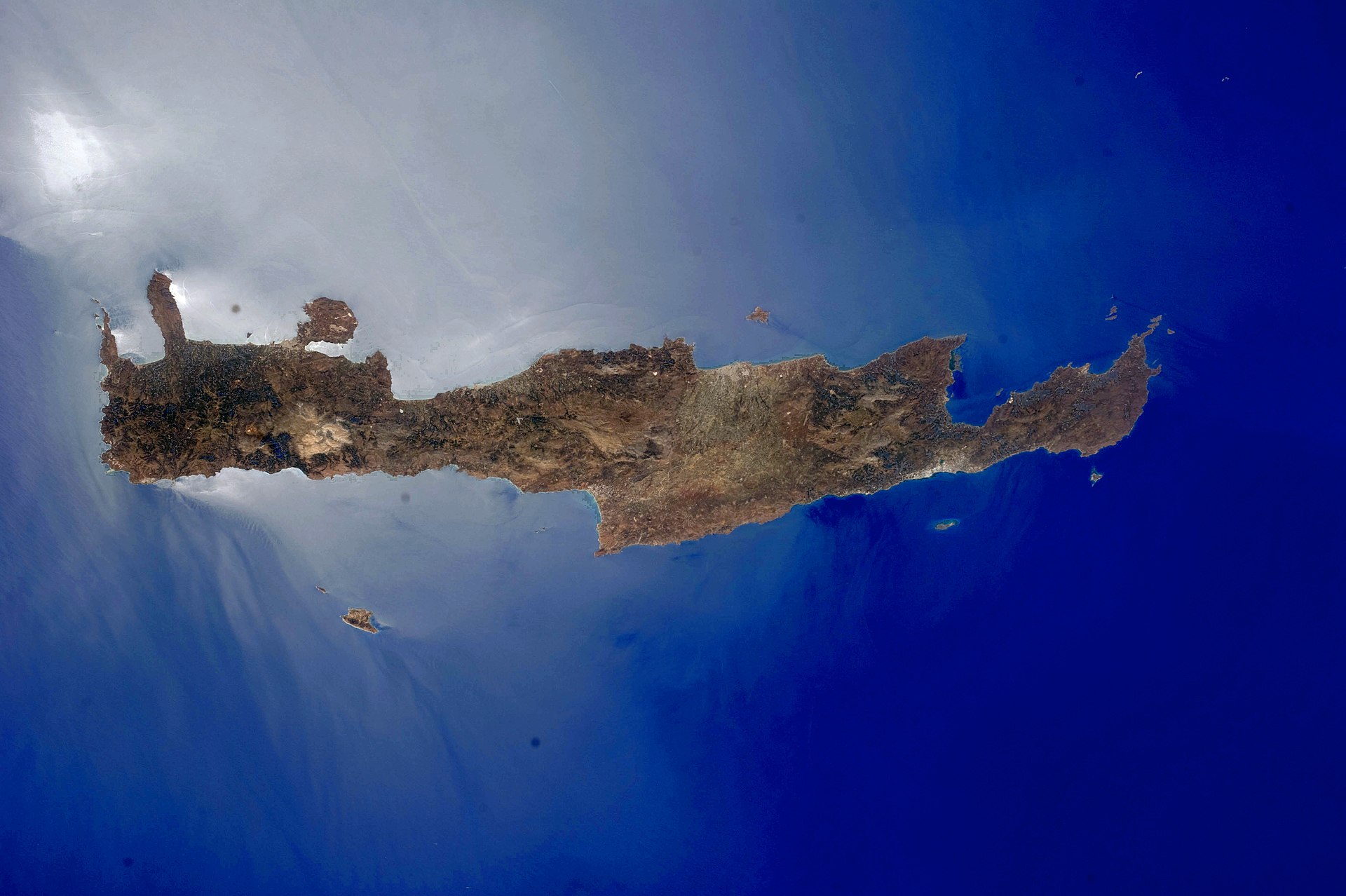
Photo: ISS Expedition 28 crew, Public domain

Quick answer
Greece's largest island stretches about 260 km from west to east, with high mountains running down its spine. The north coast holds the main towns — Chania with its Venetian harbour, Rethymno's old town and fortress, and Heraklion, base for the Minoan palace of Knossos — while the south coast has quieter villages, gorges and beaches reached by winding mountain roads. Cretan food, built on olive oil, wild greens, cheese and raki, is a reason to come in itself. Most visitors base themselves in one or two regions and hire a car. Plan 10 days for a first visit; the best months are May–June and September–October.
Key facts
- Country
- Greece
- Best time to visit
- May–June and September–October
- Ideal stay
- 10 days
- Main airports
- HER, CHQ, JSH
- Mid-range daily budget
- $130–$230 per person (estimate)
- Known for
- Knossos, Samaria Gorge, Chania's Venetian harbour and Elafonisi and Balos beaches
Why visit Crete
- Knossos and the Heraklion Archaeological Museum tell the story of the Minoans, Europe's first great Bronze Age civilisation.
- Chania's and Rethymno's Venetian harbours and old towns are among the most atmospheric in Greece.
- Beaches range from the pink-tinged lagoon of Elafonisi and the turquoise Balos lagoon to the palm-lined river mouth at Preveli.
- Hikers can walk the 16 km Samaria Gorge, the shorter Imbros Gorge or the south-coast path to car-free Loutro.
- Cretan cooking — dakos, cheese pies, slow-roasted lamb and free raki after meals — is rooted in local produce.
Top things to do
The six sights most first-time visitors build a trip around. See all 19 things to do.
Historic site · Heraklion
Knossos
The largest Minoan palace, about 5 km south of Heraklion, was the centre of a Bronze Age civilisation more than 3,500 years ago.
- Time needed
- 2 hours
- Cost
- Mid-priced
- Iconic
- History
- Kids
- Architecture


Museum · Heraklion
Heraklion Archaeological Museum
The principal collection of Minoan art, including the original frescoes from Knossos such as the bull-leaping scene, the faience snake goddesses, the bull's-head rhyton and the mysterious Phaistos Disc with its stamped spiral of symbols.
- Time needed
- 2 hours
- Cost
- Mid-priced
- History
- Art
- Rainy day
- Iconic


Waterfront · Chania Old Town
Chania Old Town and Venetian Harbour
A crescent of Venetian and Ottoman buildings lines Chania's harbour, from the domed Küçük Hasan mosque to the stone lighthouse at the end of the breakwater.
- Time needed
- Half a day
- Cost
- Free
- Iconic
- Free
- Couples
- After dark
- Photo spot

Nature · White Mountains
Samaria Gorge
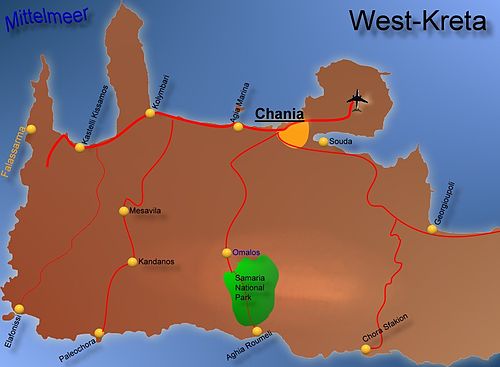
One of Europe's best-known gorge hikes runs about 16 km from the Omalos plateau down to the sea at Agia Roumeli, through pine forest and the Iron Gates, where the walls close to a few metres apart.
- Time needed
- Full day
- Cost
- Low cost
- Active
- Nature
- Outdoors
- Iconic


Beach · Kissamos
Balos Lagoon and Gramvousa
A shallow turquoise lagoon of white sand on the Gramvousa peninsula in the far northwest.
- Time needed
- Full day
- Cost
- Mid-priced
- Iconic
- Views
- Outdoors
- Photo spot


Beach · Southwest Crete
Elafonisi
A protected island and lagoon in the southwest where crushed shells tint the sand pink in places.
- Time needed
- Half a day
- Cost
- Free
- Kids
- Nature
- Photo spot
- Outdoors
Where to stay
Chania Old Town is the easiest base for a first visit. Compare all 8 areas.
$$$ · Best for first-timers, couples, food lovers and culture
Chania Old Town
Venetian harbour, lighthouse and lanes of restored mansions in the west
$$ · Best for families, beach and nightlife
Platanias and Agia Marina
Resort strip of sandy beaches west of Chania
$$ · Best for quiet stays, budget and beach
Kissamos
Small, unhurried town in the far west, close to Balos and Falasarna
$$ · Best for families, first-timers, couples and beach
Rethymno
Venetian-Ottoman old town and fortress beside a long sandy beach
What to eat
- Dakos — A hard barley rusk softened with grated tomato and olive oil and topped with crumbled mizithra or feta, oregano and olives; Crete's signature starter.
- Kalitsounia — Small pies filled with soft mizithra cheese and often mint, baked or fried; sweet versions are drizzled with honey.
- Sfakian pie — A thin, pan-fried pie filled with mizithra cheese and served with thyme honey, from the mountainous Sfakia region.
- Wedding pilaf — Rice cooked in rich broth from goat, lamb or rooster and finished with staka butter and lemon, traditionally served at Cretan weddings.
- Staka with eggs — Staka is a rich cream from sheep's or goat's milk; fried with eggs it makes a hearty, very Cretan dish.
- Fried snails — Snails fried face-down in salt and olive oil, then doused with vinegar and rosemary; a classic meze with raki.
When to go
The best times to visit Crete are May–June and September–October, when the sea is warm enough for swimming, hiking is comfortable and beaches are far less crowded than in July and August. April is lovely for wildflowers and walking but too cool for most swimmers. Winter is mild in the towns, though most resorts close.
| Season | Months | What to expect |
|---|---|---|
| Spring | March–May | Wildflowers, Easter festivities and good hiking; the sea is cool until late May. |
| Summer | June–August | Hot, dry and sunny with warm sea; peak crowds and prices in July and August, and strong winds at times. |
| Autumn | September–November | Warm sea into October, grape and olive harvests and raki-distilling season; quieter beaches. |
| Winter | December–February | Mild but rainy, with snow on the mountains; resorts close, but cities and villages carry on as usual. |
Getting there and around
Heraklion airport is about 5 km east of the city, with buses and taxis to the centre in about 15–25 minutes. Chania airport is on the Akrotiri peninsula about 15 km from the old town, linked by bus and taxi. Sitia airport in the east has a small number of flights.
Crete is large and mountainous, so travel times are longer than distances suggest. KTEL buses connect the north-coast towns and main sights, but a hire car is the practical way to reach the south coast, villages and remote beaches.
Plan your days
Crete is big: four or five days suit one region, such as Chania and the west, or Heraklion and the east. Ten days to two weeks let you combine two bases, hike a gorge and reach the south coast without long daily drives.
Practical information
- Currency
- EUR
- Language
- Greek
- Plugs
- Type C and F sockets, 230 V, 50 Hz
- Tap water
- Tap water is treated in the main towns, but quality varies by area and many people drink bottled water.
- Emergency number
- 112 (European emergency number)
- Tipping
- Service is usually not included.
Crete is generally relaxed for visitors. Take care on narrow, winding mountain roads, carry plenty of water and sun protection on gorge hikes, and respect warning flags on windy west- and north-coast beaches, where currents can be strong.
Flights to Crete
Questions travellers ask
+How many days do you need in Crete?
Crete is big: four or five days suit one region, such as Chania and the west, or Heraklion and the east. Ten days to two weeks let you combine two bases, hike a gorge and reach the south coast without long daily drives. How to split your days.
+When is the best time to visit Crete?
The best times to visit Crete are May–June and September–October, when the sea is warm enough for swimming, hiking is comfortable and beaches are far less crowded than in July and August. April is lovely for wildflowers and walking but too cool for most swimmers. Winter is mild in the towns, though most resorts close.
+What is Crete known for?
Knossos, Samaria Gorge, Chania's Venetian harbour, Elafonisi and Balos beaches, Cretan cuisine, Raki (tsikoudia) and Minoan civilisation. Knossos and the Heraklion Archaeological Museum tell the story of the Minoans, Europe's first great Bronze Age civilisation.
+Is Crete expensive?
Crete is moderately priced for international visitors: a mid-range trip costs roughly $130–$230 per person per day before flights (AMZBooking estimate). Costs and money-saving tips.
+Do you need a car in Crete?
Yes, for most visitors. Buses cover the north-coast towns and main sights, but a car makes the south coast, mountain villages, gorges and remote beaches far easier to reach.