Travel guide · Uzbekistan
Samarkand travel guide
Timurid tilework, Silk Road bazaars and the three madrasas of the Registan
Updated By the AMZBooking editorial team
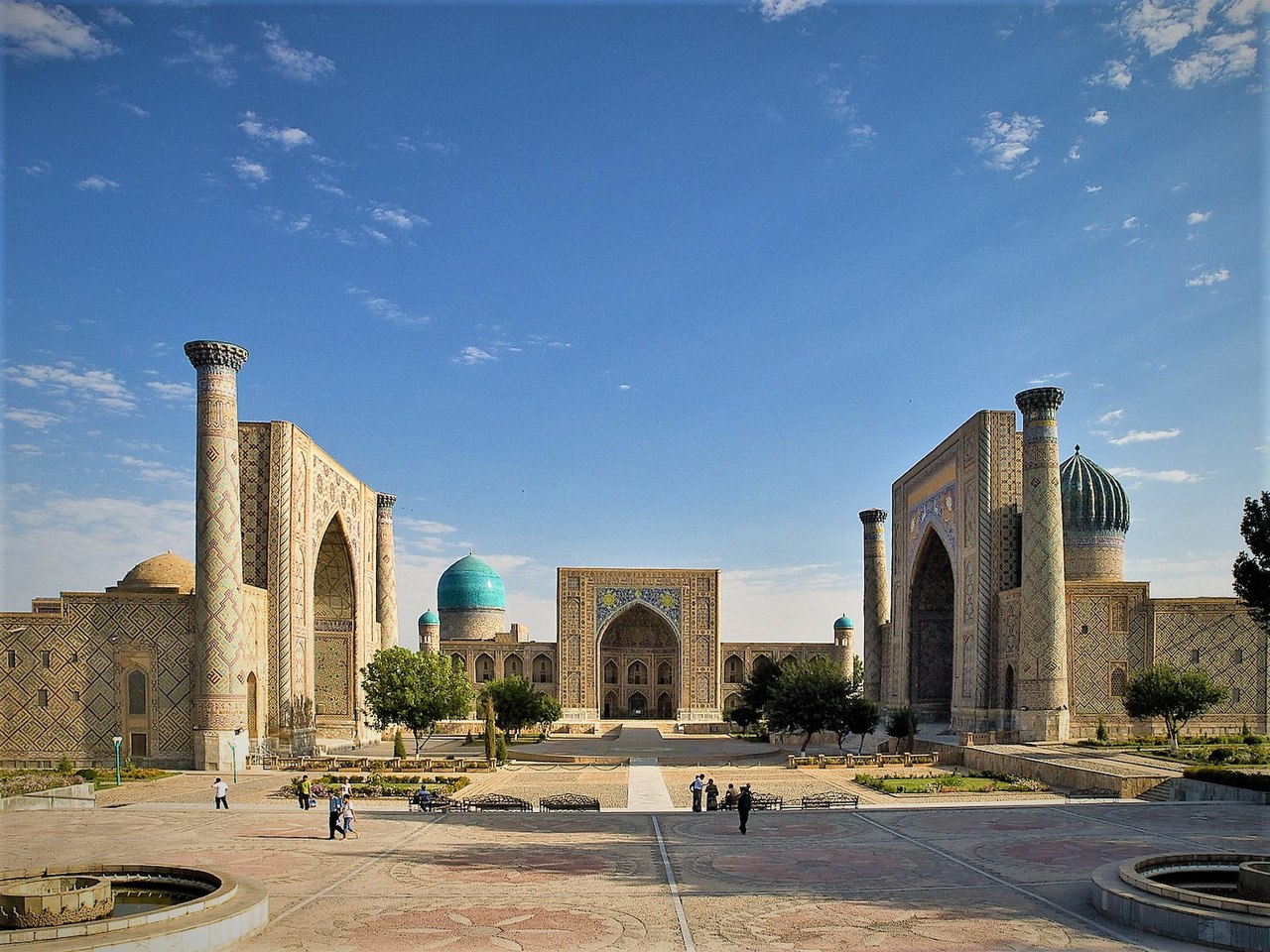
Photo: Registan_-_Gusjer.jpg : Gustavo Jeronimo from Aranjuez, Spain derivative work: MrPanyGoff, CC BY 2.0

Quick answer
Samarkand was Timur's capital in the late 14th century, and the turquoise domes he and his heirs built still define the city: the three tiled madrasas of the Registan, the ribbed dome of Gur-e-Amir, the vast Bibi-Khanym Mosque and the street of mausoleums at Shah-i-Zinda. The main monuments sit within a 30-minute walk of each other, linked by the pedestrian Tashkent Street and the Siab Bazaar. West of the old town, the plane-tree boulevards of the 19th-century Russian quarter hold many hotels and restaurants, and high-speed trains make Bukhara and Tashkent easy onward hops. Plan 3 days for a first visit; the best months are April–May and September–October.
Key facts
- Country
- Uzbekistan
- Best time to visit
- April–May and September–October
- Ideal stay
- 3 days
- Main airports
- SKD
- Mid-range daily budget
- $70–$140 per person (estimate)
- Known for
- Registan, Timurid architecture, Gur-e-Amir and Shah-i-Zinda
Why visit Samarkand
- The Registan's three madrasas, built between 1417 and 1660, form one of the most complete ensembles of Islamic architecture anywhere.
- Shah-i-Zinda lines a single stepped lane with 14th- and 15th-century mausoleums covered in carved and glazed tilework.
- Samarkand plov and the city's dense, stamped round bread are national benchmarks, best tried at lunchtime plov centres and the Siab Bazaar.
- Most major sights are within walking distance of each other, so two or three days covers the city without a car.
- Shahrisabz, Timur's birthplace, and the Urgut bazaar make easy day trips, and Bukhara is about 90 minutes away by high-speed train.
Top things to do
The six sights most first-time visitors build a trip around. See all 16 things to do.

Landmark · Registan and Old Town
Registan
Samarkand's old public square is framed by three madrasas: Ulugh Beg's (1417–1420), the Sher-Dor (1619–1636) with its mosaics of tigers chasing deer beneath sun faces, and the Tilya-Kori (1646–1660), whose mosque interior is covered in gilding.
- Time needed
- 2–3 hours
- Cost
- Low cost
- Iconic
- Architecture
- History
- After dark
- Photo spot


Historic site · Gur-e-Amir quarter
Gur-e-Amir
Timur's mausoleum, begun in 1403 for his grandson Muhammad Sultan, has a ribbed turquoise dome over an interior of gold leaf and onyx.
- Time needed
- 1 hour
- Cost
- Low cost
- Iconic
- History
- Architecture
- After dark


Historic site · Afrasiyab
Shah-i-Zinda
A stepped lane climbs past about twenty mausoleums built mainly in the 14th and 15th centuries for Timur's relatives and nobles, ending at the shrine of Kusam ibn Abbas, a cousin of the Prophet Muhammad.
- Time needed
- 1–1.5 hours
- Cost
- Low cost
- Iconic
- Architecture
- History
- Photo spot


Religious site · Siab Bazaar and Bibi-Khanym
Bibi-Khanym Mosque
Timur ordered this enormous Friday mosque after his Indian campaign of 1398–99, and it was finished around 1404.
- Time needed
- 45 minutes
- Cost
- Low cost
- Iconic
- Architecture
- History
Market · Siab Bazaar and Bibi-Khanym
Siab Bazaar
The city's main bazaar sits beside Bibi-Khanym and is where locals buy Samarkand bread, dried apricots, raisins, almonds, spices, halva and crystallised sugar (navat).
- Time needed
- 1 hour
- Cost
- Free
- Food
- Shopping
- Free
- Photo spot
- Kids
Street · Registan and Old Town
Tashkent Street
This pedestrianised street runs from the Registan to Bibi-Khanym and the Siab Bazaar, lined with souvenir shops selling suzani embroidery, ceramics, ikat silk and carpets.
- Time needed
- 30–60 minutes
- Cost
- Free
- Free
- Shopping
- After dark
Where to stay
Registan and Old Town is the easiest base for a first visit. Compare all 6 areas.
$$ · Best for first-timers, culture, couples and solo travellers
Registan and Old Town
Guesthouses in lanes around the three madrasas and the Chorsu dome
$ · Best for food lovers, budget and culture
Siab Bazaar and Bibi-Khanym
Market stalls, bread sellers and the giant mosque at the north end of Tashkent Street
$$ · Best for quiet stays, couples and first-timers
Gur-e-Amir quarter
Quiet residential streets around Timur's mausoleum
$$ · Best for families, first-timers and food lovers
Russian New Town
Plane-tree boulevards, larger hotels and cafés west of the old city
What to eat
- Samarkand plov — Samarkand's version of Uzbekistan's national rice dish is cooked in layers that are not stirred together: rice on the bottom, yellow and orange carrot strips above, and chunks of beef or lamb on top, often with quail eggs, chickpeas or raisins.
- Samarkand bread — The city's dense, glossy round loaf has a thick rim and a centre stamped with patterns, baked against the walls of a clay tandir oven.
- Tandir somsa — Flaky pastry triangles filled with minced lamb or beef, onion and lamb fat, baked against the wall of a tandir oven.
- Shashlik — Skewers of lamb, beef, minced meat (lyulya) or liver grilled over charcoal, served with raw onion and vinegar and a round of bread.
- Lagman — Hand-pulled noodles in a meat-and-vegetable sauce of peppers, tomatoes and garlic, served either as a soup or stir-fried and drier (qovurma lagman).
- Shurpa — A clear, long-simmered broth with large pieces of lamb on the bone, potato, carrot and chickpeas, sprinkled with herbs.
When to go
The best times to visit Samarkand are April to May and September to October, when days are warm but not hot and the light on the tilework is soft. July and August regularly pass 33°C, so sightseeing shifts to early mornings and evenings. Winter is cold and quiet, with the lowest hotel prices. Ramadan moves about 11 days earlier each year; daily life and sightseeing continue largely as normal.
| Season | Months | What to expect |
|---|---|---|
| Spring | March–May | Blossom, green hills and mild days, with Navruz celebrations in March and the most rain of the year in March and April. |
| Summer | June–August | Hot, dry and bright with little shade at the monuments; fruit season in the bazaar and long, warm evenings. |
| Autumn | September–November | The most popular season, with warm days, harvest produce and golden light, cooling quickly in November. |
| Winter | December–February | Cold, frosty and quiet, with occasional snow on the domes and the lowest prices of the year. |
Getting there and around
Samarkand International Airport is on the northern edge of the city, about 15–20 minutes by taxi from the Registan. A ride-hailing app or a hotel pick-up is the simplest way into town.
The old town is walkable: the Registan, Gur-e-Amir, Bibi-Khanym, the Siab Bazaar and Shah-i-Zinda all lie within about a 30-minute walk. Ride-hailing taxis cover the outlying sights such as the Ulugh Beg Observatory and Konigil, and high-speed trains link the city to Tashkent and Bukhara.
Plan your days
Two days covers the Registan, Gur-e-Amir, Bibi-Khanym, the Siab Bazaar and Shah-i-Zinda. A third day adds the Ulugh Beg Observatory, the Afrasiyab murals and the Konigil paper mill; a fourth allows a day trip to Shahrisabz or Urgut.
Practical information
- Currency
- UZS
- Language
- Uzbek, Tajik and Russian
- Plugs
- Type C and F sockets, 220 V, 50 Hz
- Tap water
- Do not drink tap water; bottled water is sold everywhere and hotels often provide it.
- Emergency number
- 102 police, 103 ambulance, 101 fire
- Tipping
- Restaurants usually add a service charge of about 10–15%.
Samarkand is generally calm for visitors. The main issues are overcharging by street taxis and souvenir sellers, and heat exhaustion in summer; use ride-hailing apps, agree prices first and carry water.
Flights to Samarkand
Questions travellers ask
+How many days do you need in Samarkand?
Two days covers the Registan, Gur-e-Amir, Bibi-Khanym, the Siab Bazaar and Shah-i-Zinda. A third day adds the Ulugh Beg Observatory, the Afrasiyab murals and the Konigil paper mill; a fourth allows a day trip to Shahrisabz or Urgut. How to split your days.
+When is the best time to visit Samarkand?
The best times to visit Samarkand are April to May and September to October, when days are warm but not hot and the light on the tilework is soft. July and August regularly pass 33°C, so sightseeing shifts to early mornings and evenings. Winter is cold and quiet, with the lowest hotel prices. Ramadan moves about 11 days earlier each year; daily life and sightseeing continue largely as normal.
+What is Samarkand known for?
Registan, Timurid architecture, Gur-e-Amir, Shah-i-Zinda, Samarkand plov, Samarkand bread, Silk paper and Silk Road history. The Registan's three madrasas, built between 1417 and 1660, form one of the most complete ensembles of Islamic architecture anywhere.
+Is Samarkand expensive?
Samarkand is affordable for international visitors: a mid-range trip costs roughly $70–$140 per person per day before flights (AMZBooking estimate). Costs and money-saving tips.
+Do you need a car in Samarkand?
No. The monuments are walkable and taxis are inexpensive; for Shahrisabz and Urgut, hire a car with a driver or take a shared taxi rather than driving yourself.